Introduction.
Monzo is often described as the bank that doesn’t feel like a bank. Since its launch, it has disrupted the financial sector not just through its product but through the way it manages and governs its brand. Where traditional banks rely on rigid controls, Monzo has embedded purpose and values into its culture, created practical tools like tone of voice guides, and built agile processes that allow consistency without slowing innovation.
This case study explores how Monzo balances speed, flexibility, and control – and what other organisations can learn from its approach.
1. Purpose and values embedded in culture.
Monzo’s founding purpose is simple but ambitious: “Making money work for everyone.” Unlike many financial institutions, this isn’t just a tagline – it shapes the organisation’s culture and everyday decisions.
Transparency, fairness, and customer-first thinking underpin every aspect of the business. For example, Monzo was the first bank to introduce instant notifications for every transaction. This wasn’t a gimmick. It was a deliberate move to give customers control and visibility – an embodiment of their purpose.
Key takeaway: When brand purpose is woven into company culture, it becomes a compass for decision-making. Governance is easier because employees already understand the “why” behind their work.
2. Tone of voice as a governance tool.
Monzo’s tone of voice guidelines are a standout feature of its governance model. They provide practical, easy-to-use rules that keep communication consistent across teams:
- Write in a friendly, human voice – like you’re talking to a friend.
- Keep it clear and simple – avoid jargon and make financial language accessible.
- Show empathy – acknowledge and care about customer concerns.
For example, where a traditional bank might say, “Your payment could not be processed due to an authentication error,” Monzo rephrases: “Oops! We couldn’t process your payment this time – please try again.”
These guides are not abstract; they include real examples, templates, and training exercises. They’re used to onboard new staff and to check communications before they go out.
The full Monzo Tone of Voice Guide is publicly available. It’s packed with principles, real examples, and templates for typical scenarios. Internally, it’s used to train new staff, guide customer service teams, and review content before publication.
Key takeaway: Tone of voice guidelines empower teams to act independently, reducing bottlenecks while ensuring a consistent brand experience.
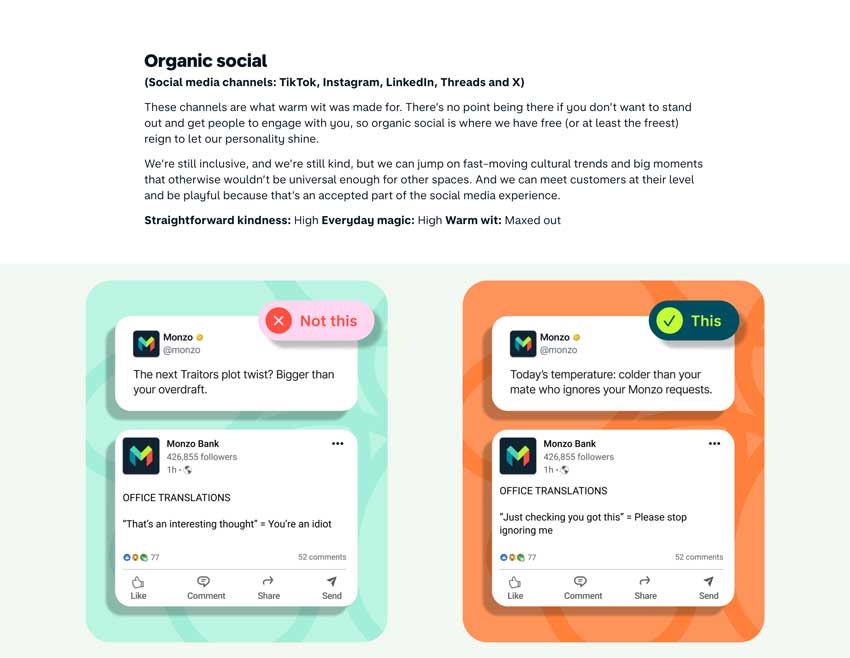 Monzo tone of voice guidelines.
3. Clear roles and responsibilities.
Monzo avoids the trap of centralised brand policing by clearly defining who is responsible for what:
- Leadership sets vision, values, and strategic direction.
- Brand team creates guidelines, toolkits, and training, while providing support and approvals where necessary.
- Marketing and product teams apply the guidelines, aligning campaigns and product design with the brand promise.
- Local/functional teams adapt brand assets for their audiences, without losing the core identity.
- Customer support teams embody the brand daily, handling interactions with empathy and clarity.
This division of responsibility ensures governance is distributed and embedded, rather than siloed.
Key takeaway: Governance works best when everyone understands their role, boundaries, and the support available.
4. Agile governance and feedback loops.
Traditional banks often rely on rigid sign-off processes that slow everything down. Monzo flips this by building lightweight, agile governance processes.
- Content and product updates are peer-reviewed quickly in Slack and collaborative tools.
- Customer feedback from NPS, app reviews, and social media is monitored in real time.
- Teams hold retrospectives to reflect on what worked and adapt processes for the future.
This balance of speed and control means Monzo maintains consistency without stifling innovation.
Key takeaway: Agile governance allows brands to respond quickly in dynamic markets without compromising identity.
5. Transparency as a differentiator.
Transparency isn’t just one of Monzo’s values – it’s built into their governance model. When something goes wrong, Monzo owns the problem publicly.
During a major outage, Monzo published a clear timeline of events, explained the cause, and outlined steps to prevent it happening again. This level of openness is rare in banking, and it has become part of what customers expect from the brand.
Key takeaway: Transparency, when consistently applied, builds credibility and strengthens trust – even during crises.
 Monzo tone of voice guidelines.
6. Lessons from Monzo.
Monzo’s approach shows that governance doesn’t have to mean bureaucracy. Theirs is lean, empowering, and aligned to culture. The key lessons are:
- Purpose guides decisions at every level.
- Simple, practical tools (like tone of voice guides) give teams confidence.
- Clear roles reduce confusion and duplication.
- Agile processes protect consistency while allowing innovation.
- Transparency turns even difficult moments into opportunities to reinforce trust.